$589 Billion Gone in a Day: DeepSeek Rewrites What Frontier AI Costs
A cheap Chinese reasoning model hit number one in the App Store and triggered the biggest one-day loss in market history.
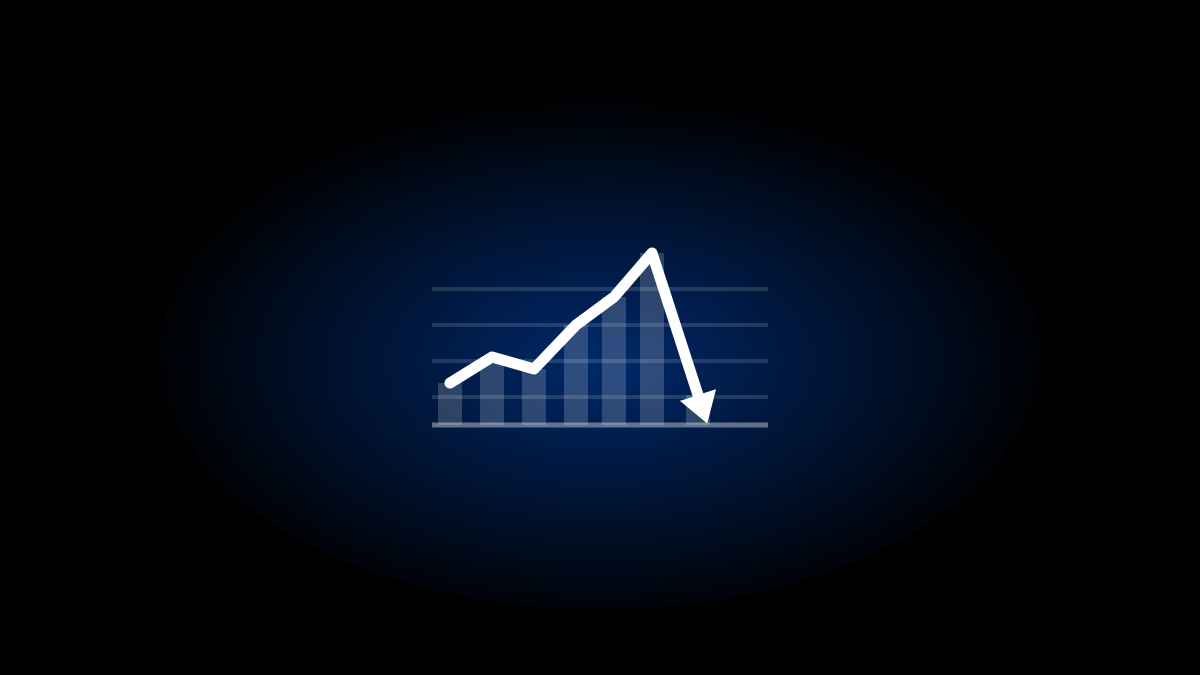
On Monday 27 January 2025, Nvidia's share price fell by nearly 17 percent in a single trading session. The company shed 589 billion dollars of market value in one day, the largest single-day loss on record at the time. The move did not follow any announcement from Nvidia itself. What changed was a claim about somebody else's software.
A week earlier, on 20 January, a Chinese lab called DeepSeek had released a reasoning model named R1 and attached a number to it: the training run had cost 5.6 million dollars. For comparison, OpenAI's GPT-4 was reported to have cost more than 100 million dollars to train. If a capable model could be produced for a fraction of that, then the assumption holding up the entire trade — that frontier AI needs ever more of Nvidia's chips in ever larger data centres — looked less solid on Monday than it had on Friday.
The selling was not limited to one company. Broadcom fell more than 17 percent, Micron almost 12 percent, AMD more than 6 percent. The reaction had a particular sting to it, because the United States had been tightening export restrictions precisely to limit what Chinese firms could obtain from Nvidia, and days earlier the Stargate project had been announced with 100 billion dollars for American data centres and 400 billion more over four years.
The figure that moved the market was the one worth doubting
The 5.6 million dollars did not go unchallenged. Bernstein analyst Stacy Rasgon said the figure "does not include all the other costs" — by which he meant the prior research and the experiments on architectures, algorithms and data that came before the successful run. He also judged the reaction disproportionate to what had actually been announced. A training-run invoice is not a company's AI budget, and treating one as the other is how a headline becomes a selloff.
Strip the arithmetic away, though, and something real remained. Raymond James analyst Srini Pajjuri framed it as a conditional: if DeepSeek's innovations were adopted broadly, an argument could be made that model training costs come down significantly. Nvidia itself, whose shareholders had just had an expensive morning, publicly called R1 an excellent AI advancement. The investor Marc Andreessen described it as one of the most impressive breakthroughs he had seen.
That is the distinction worth holding on to. The market moved on a number that at least one analyst on the record considered incomplete. The direction behind it was less contested: methods for getting strong results out of less compute exist, and if they are taken up widely the cost of training could fall a long way. The possibility alone was enough to take 589 billion dollars off one company between the opening bell and the close.
What this means if you are building something
Requote anything you priced in 2024. If a proposal on your desk carries a per-month figure for an AI feature — a support assistant, document extraction, a search box that answers in sentences — that figure was calculated against last year's model prices. The premise behind Monday's selloff is that the cost of producing capable models may be about to fall further. Ask for the arithmetic to be redone before signing, and ask what happens to the price if the underlying model gets cheaper mid-contract.
Put open-weight models on the shortlist. An open-weight model is one whose files you can download and run on infrastructure you choose, rather than calling somebody else's service and paying per request. Two kinds of project should consider one seriously: work with a hard budget ceiling, where a fixed server beats an unpredictable metered bill, and work where the data cannot leave a particular country or a particular building. Health records, legal files and public-sector work often fall into the second group, and for a long time the strongest models in that situation were only available as somebody else's API.
Do not rebuild anything on a single day's price move. The sensible response to Monday is not to switch providers. It is to make sure the model is a replaceable part — one setting, one adapter, one place in the code — so that when it becomes cheaper or better to move, moving is a small job rather than a project. Any developer who tells you the choice of model is baked into the architecture has built you something more expensive than it needed to be.
Our position: treat the 5.6 million dollars as an incomplete figure and the question it raises as a real one. Before signing anything quoted in 2025, ask whether the arithmetic behind it is still last year's.
Sources